President Donald Trump’s second-term trade policies are shaking up the market in ways that landlords, developers and homebuyers can’t afford to ignore. From surging rents to stalled construction projects, the impact of tariffs is rippling through the industry. The uncertainty surrounding Trump’s tariffs and economic policies is pushing potential homebuyers to the sidelines, and that hesitation is driving rental prices to record highs.
In New York City, Manhattan’s median rent hit a fresh high of $4,500 in February — its highest level since 2023. Brooklyn and Queens are feeling the pressure too, with Brooklyn rents averaging over $4,000 and Northwest Queens surpassing $3,400.
Chicago isn’t far behind. Downtown apartment rents just broke the $3,000 threshold for the first time ever, and with supply cratering due to high construction costs, developers are holding back — meaning rents are only expected to spike further in 2025.
Tenants are afraid to take the plunge into homeownership amid fluctuating mortgage rates and economic instability. The result is lower vacancy rates, more bidding wars and landlords with the upper hand. With summer around the corner, expect even higher rents in the months ahead.
While mortgage rates have dipped since Trump’s return to the White House, experts say the unpredictability surrounding his tariffs is outweighing any potential savings — causing some renters who once considered buying to think again.
The outlook for new homes isn’t any rosier, and homebuilders are scrambling. Trump’s tariffs on steel, aluminum and lumber imports are driving up costs, forcing builders to get creative. Some are stockpiling materials, gambling that today’s prices are better than what’s to come. Others are shrinking floor plans or pivoting to modular construction. The National Association of Home Builders estimates these tariffs could add $7,500 to $10,000 to the cost of a new home. And in places like California, where developers are already dealing with fire recovery costs, the added expense could mean the difference between rebuilding and walking away from projects altogether.
While Trump’s unpredictability has long been a hallmark of his economic policy, the former Cantor Fitzgerald head’s mixed messaging is keeping investors and industry players on edge.
In Texas, where industrial development has been booming, big players like Ross Perot Jr. are considering baking “tariff clauses” into contracts to prepare for rising costs. Meanwhile, Citadel founder Ken Griffin isn’t mincing words — calling Trump’s trade policies a “huge mistake” that could cripple the economy. Huge mistake or not, the uncertainty and chaos surrounding Trump’s tariffs is certainly making it difficult to stay ahead of the curve.
There’s no perfect time to buy a home – every market has trade-offs. If you’re ready and can afford it, lean on a pro to make the most of current trends.
NEW YORK — It’s easy to get caught up in the idea of waiting for the perfect moment to make your move — especially in today’s market. Maybe you’re holding out and hoping mortgage rates will drop, or that home prices will fall. But here’s what you need to realize: trying to time the market rarely works. And here’s why.
There is no perfect market
No matter when you buy, there’s always some benefit and some sort of trade-off — and that’s not a bad thing. That’s just the reality of it. If you’re not sure you buy into that, think back to the last five years in housing.
Just a few years ago, mortgage rates hit a historic low. To take advantage of that, a ton of buyers rushed to buy a home and lock in those lower rates. The side effect? With such a big increase in how many buyers were purchasing, the homes on the market were snapped up fast. And since that resulted in so few homes left for sale, bidding wars became the norm and home prices went through the roof. Those buyers got a great rate, but they had other things to contend with.
Now, with higher rates and higher prices, it’s more expensive to buy. You can’t argue that. But at the same time, the number of homes for sale is at the highest point in several years. That means you have more options to choose from and you’ll be less likely to find yourself in a pull-out-all-the-stops bidding war. Again, there are benefits and trade-offs in any market.
So, if you have a reason to move and can afford to do so, you’ve got to take advantage of the trends that work in your favor and lean on a pro to help you navigate the rest. As Bankrate says:
“The complexities of the current conditions mean that, now more than ever, it’s smart to lean on the guidance of an experienced local real estate agent. If you want to enter the housing market in 2025, whether as a buyer or a seller, let a pro lead the way for you.”
While achieving your goals may feel like an uphill battle in today’s complex market, it is doable. But you’ll need the help of a trusted real estate agent and a lender.
Your agent will help you explore creative solutions — like looking into different housing types (like smaller condos), considering homes that need a little elbow grease, or casting a wider net for your search area. And your lender will walk you through different loan options and down payment assistance programs, so you know what you need to do to make the numbers work for you. As Yahoo Finance says:
“Buying a house at a time when both mortgage rates and home prices are favorable is a challenge. You probably shouldn’t try to time the housing market … Buy when it makes sense for you personally.”
Bottom line
There’s no perfect time to move — every market has its pros and cons. The key is knowing how to make the most of the factors working in your favor. If you need to move and can afford to do it, let’s connect so you’ll have the guidance and tools to make it possible.
Survey: Most would-be buyers (55%) know it’s a really tough market right now, but a majority (54%) still plan to maintain current goals or speed up the buying process.
CHARLOTTE, N.C. – Many hopeful homebuyers – especially those in their 40s and younger – are forging ahead with plans to buy homes despite believing the market favors sellers, according to Bank of America’s 2023 Homebuyer Insights Report.
More than half of prospective homebuyers surveyed (55%) believe the market is more competitive than last year – but just as many (54%) plan to either speed up their home purchases or buy when they originally planned.
The percentage is even greater for younger generations: 62% of Gen Z and 55% of millennials.
However, not all want-to-be buyers plan to stay in the market, at least not now. Two in five (39%) believe it’s a seller’s market, while 18% say it’s a buyer’s market and 31% say it’s neither.
Current challenges cited by buyers
High prices and interest rates (51%)
A lack of cash reserves for down payments (37%)
A low credit score (37%)
Still, nearly 40% of those prospective homebuyers said they feel more confident in their ability to buy a home today versus last year, compared to 26% who are less confident and 28% who feel about the same.
“The market is less frenzied as rates have moderated, and that may be impacting perception,” says Matt Vernon, head of retail lending at Bank of America. “And low inventory is still creating a highly competitive environment. Homebuyers are doing the right thing by taking time to understand the market, weigh their priorities and determine what fits into their budgets.”
The motivation for many buyers? Financial security. Homeownership has historically helped families build long term-wealth.
A majority (56%) of Gen Z and the same percentage of millennial homebuyers plan to purchase in the next two years – nearly on par with Gen X (58%).
Nearly half (47%) of all prospective buyers say they’d buy a home in the current housing market because they’re tired of renting and of rent increases; 28% want to start building equity.
Inactive homebuyers still curious
Even hopeful buyers waiting for the housing market to cool are forging ahead in their own way, according to the study: More than two-thirds (67%) still actively look at homes for sale, either scrolling through a real estate app (52%) and/or visiting open houses (31%).
Those scanning for homes find it to be an enjoyable pastime (41%), a way to dream about their future home (37%) and a window into how others have decorated their spaces (32%).
Beyond simply looking for inspiration, two-thirds (65%) of those who scroll through listings are interested in what their current budget would get them if they were to buy today.
Sabrina Speianu, Economic Data Manager, realtor.com®
The national inventory of active listings increased by 26.6% over last year.
The total inventory of unsold homes, including pending listings, increased by just 1.3% year-over-year due to a decline in pending inventory (-21.9%).
Selling sentiment declined and listing activity followed, with newly listed homes declining by 13.4% on a year-over-year basis.
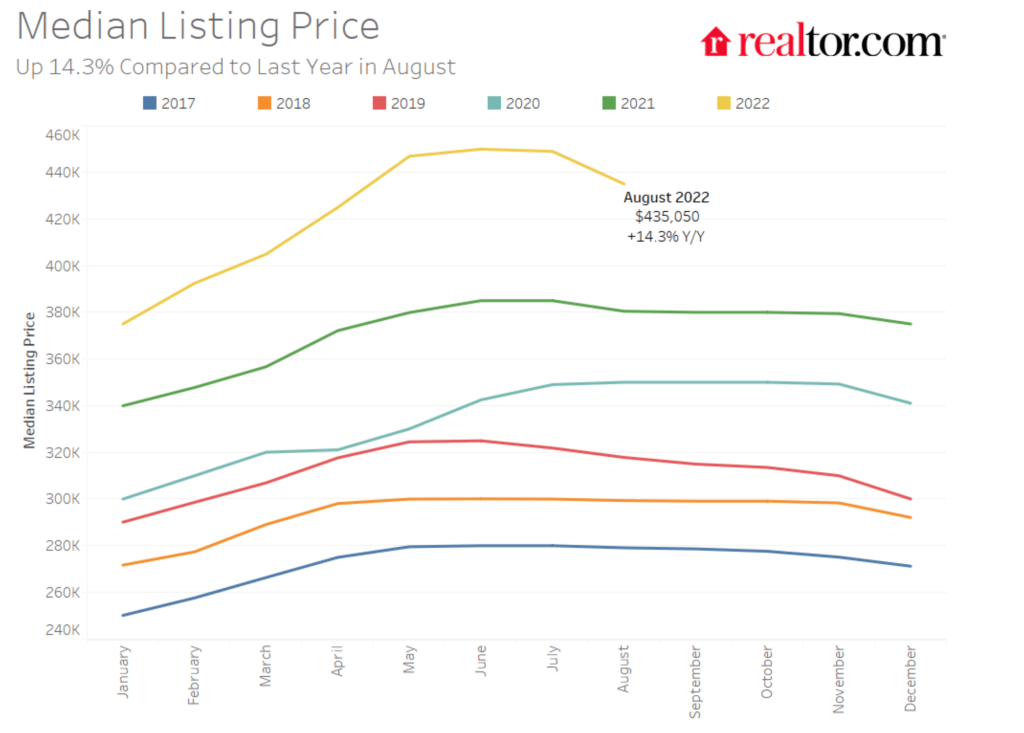
The median list price grew by 14.3% in August, a deceleration from recent highs.
Time on market was 42 days, 5 days more than last year but 22 days less than typical pre-pandemic levels.
Regionally, large Western markets which saw some of the most growth last year and earlier this year are now showing the greatest signs of deceleration, with larger inventory increases, more price reductions, and more quickly decelerating price growth than other regions.
Federal Reserve Chair Jerome Powell testifies about monetary policy and the state of the economy before the House Financial Services Committee on Wednesday. Powell reiterated the Fed is gearing up to raise interest rates this month.
Federal Reserve Chair Jerome Powell said on Wednesday the central bank is on track to start raising interest rates this month — likely by a quarter percentage point — in an effort to combat inflation, which is the highest it’s been in nearly 40 years.
But the Fed will proceed with caution, Powell told the House Financial Services Committee, as Russia’s invasion of Ukraine adds more uncertainty to the economic outlook.
“The economics of these events are highly uncertain,” Powell said. “So far, we’ve seen energy prices move up further and those increases will move through the economy and push up headline inflation, and also they’re going to weigh on spending.”
The average price of gasoline in the U.S. approached $3.66 per gallon on Wednesday. Rising energy prices have been a significant driver of annual inflation, which hit 7.5% in January – the highest level since 1982.
Powell says it’s too soon to tell on Ukraine
Powell said it’s too soon to know how large or long-lasting price increases tied to events in Ukraine will be, so he and his colleagues on the central bank’s rate-setting committee are prepared to be flexible.
“We’re never on auto-pilot,” Powell said. “Those of us on the committee have an expectation that inflation will peak and begin to come down this year. And to the extent that inflation comes in higher or is more persistently high than that, then we would be prepared move more aggressively.”
Forecasters expect the Fed to impose additional interest rate hikes later this year in an effort to cool red-hot consumer demand, which has outstripped supply and driven prices sharply higher.
A year before his death, he launched the Poor People’s Campaign to fight job and housing inequality, among other issues. Historians say the Poor People’s Campaign and the Chicago Open Housing Movement laid the groundwork for the 1968 Fair Housing Act
Trikosko, Marion S.,/Library of CongressBY MARIAN MCPHERSONJanuary 15, 2018
This post was last updated Jan. 14, 2022. – Inman News
Although Martin Luther King, Jr. is most remembered for his struggle to secure voting rights and stop segregation, the civil rights icon’s dream of racial equity reached far beyond integrated public life — it also included economic security and housing rights for the millions of minority and low-income Americans who’d been relegated to their cities’ under-resourced neighborhoods and housing projects.
King began planting the seeds of what would become the Poor People’s Campaign in Chicago, where thousands of Black Chicagoans struggled with job and housing insecurity — something they’d hoped they escaped during the Great Migration, the term used to describe a decades-long exodus from the fields of the South to the factories of the North.
Although some Black people found great success in Chicago, Detroit, New York City and other similar places, many more found the only thing that changed in their life was their address.
“We are here today because we are tired,” Dr. King said, according to a transcript of a speech he made at Chicago’s Soldier Field. “We are tired of paying more for less. We are tired of living in rat-infested slums … We are tired of having to pay a median rent of $97 a month in Lawndale for four rooms while whites living in South Deering pay $73 a month for five rooms.”
“Now is the time to make real the promises of democracy,” he added. “Now is the time to open the doors of opportunity to all of God’s children.”
According to articles by HuffPost and NPR, Dr. King spent much of 1966 in Chicago, even moving his family to an apartment on the city’s predominately Black west side. There, King and Southern Christian Leadership Conference (SCLC) launched the Chicago Open Housing Movement, whose goals included the rehab of public housing, increasing the supply of affordable housing, pushing for diversity and integration in businesses and unions, a $2 minimum wage and the abolition of wage garnishment.
Over the course of the year, King and SCLC activists held citywide rallies, planned demonstrations in front of real estate brokerages and marched into Chicago’s all-white neighborhoods, which were met with violent reactions from the city’s white residents. “Well, this is a terrible thing,” King said in a soundbite acquired by NPR. “I’ve been in many demonstrations all across the South, but I can say that I have never seen, even in Mississippi and Alabama, mobs as hostile and as hate-filled as I’m seeing in Chicago.”
Eager to quell the violence, Chicago’s mayor, Richard J. Daley, agreed to meet with King and other activists in August 1966 to work out an agreement, which included building future public housing with “limited height requirements,” and requiring the Mortgage Bankers Association to make mortgages available regardless of race.
King hailed the agreement ‘‘the most significant program ever conceived to make open housing a reality,’’ but tempered his assessment by recognizing it as only “the first step in a 1,000-mile journey.’’
The next year, King went back to the South and began planning the Poor People’s Campaign, which was built from his experiences in Chicago the year before. He and the SCLC began creating a blueprint for economic and housing equity that addressed the systems and policies that kept minority and low-income communities behind the eight ball.
“This is a highly significant event,” King told the SCLC in November 1967, according to an archive at Stanford’s King Institute. “[This] the beginning of a new co-operation, understanding, and a determination by poor people of all colors and backgrounds to assert and win their right to a decent life and respect for their culture and dignity.”
He garnered support from civil rights leaders in American Indian, Puerto Rican, Mexican American, and poor white communities and began planning another March on Washington to demand jobs, unemployment insurance, a fair minimum wage, and education for adults and children. “It’s as pure as a man needing an income to support his family,” King said.
King was assassinated before he could finish planning the demonstration; however, other SCLC leaders and his wife, Coretta Scott King, banned together and finished planning the march, which took place on Mothers’ Day 1968. After the initial demonstration, protestors pitched tents on the Mall in Washington and lobbied for fair employment and housing policies until their park permit expired a month later.
Even though the campaign was largely unsuccessful in making widespread change — they did secure free food surplus distribution to 200 counties — historians say the Poor People’s Campaign and the Chicago Open Housing Movement laid the groundwork for the 1968 Fair Housing Act, which ensures that all Americans have access to equal housing opportunities and outlaws discrimination based on an individual’s race, color, religion, sex, national origin, disability or familial status.
“And we have to continue in the legacy of MLK and the civil rights movement and the legacy of abolition movements of before,” said Paige May, a Chicago resident who spoke to NPR after an event to celebrate MLK.
“We have a lot of work to do, but it’s also — it feels like a day that’s celebratory in a lot of ways, right? But in the sphere of struggle and resistance.”
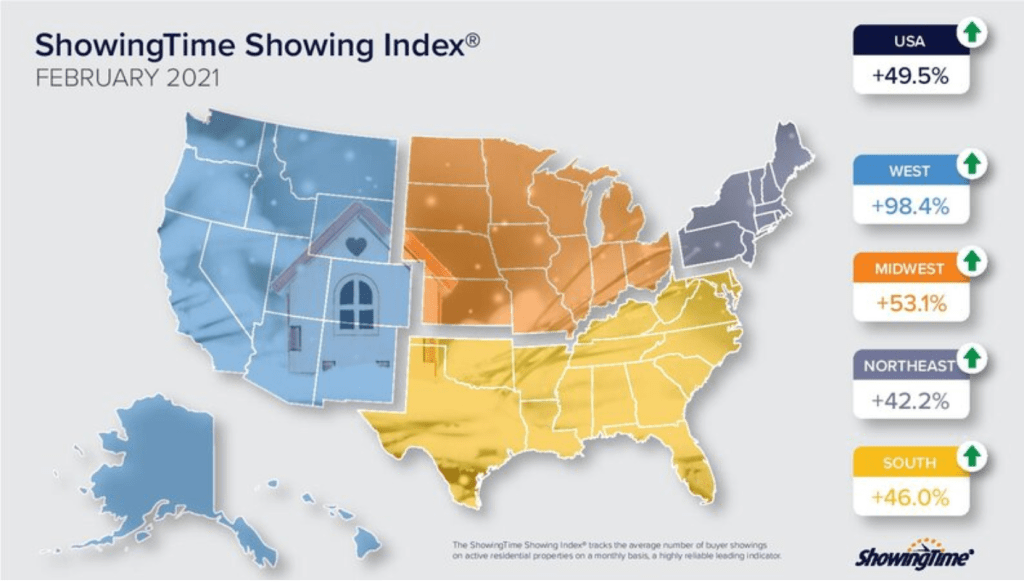
Based on compiled data from more than six million property showings scheduled across the country, Home Buyer Demand jumps 98.4% in the West as traffic grows again nationwide.
March 24, 2021 – Dwindling inventory was again met with an outpouring of buyer demand throughout the country in February as an unprecedented 75 markets reported double-digit growth, according to the ShowingTime Showing Index®
Nationwide, buyer traffic jumped 49.5 percent, continuing a trend of national year-over-year growth in buyer demand that began in May 2020.
“In March and April, year-over-year comparisons will be less meaningful as the onset of COVID-19 in 2020 drove showing traffic down in those two months, but on a month-to-month basis we’re still likely to see further seasonal increases in demand, taking us further into this unprecedented direction. We expect that this will correlate with continued broad increases in prices.”
Where To Spend All That Savings | An Opportunity To Build Wealth
Americans have saved $1.6 trillion since the pandemic started, per the Commerce Department.
That’s roughly half of overall global savings during the pandemic, and the same as South Korea’s GDP.
It’s also greater than the output gap, or economic hole created by Covid-19, signaling a coming economic boom.
Experts are currently projecting 4.6% growth for US GDP this year, per Bloomberg. If Americans spend all the money they saved in the past year, that could jump to 9%; whereas if they don’t, the GDP forecast could drop to 2.2%.
It’s why so many economists are predicting that lockdown lifting will see the biggest boomtime in a generation, potentially ushering in a new era in the US economy.
These real estate markets reported record-setting activity in 2020, despite enduring a weaker spring market due to social distancing protocols.
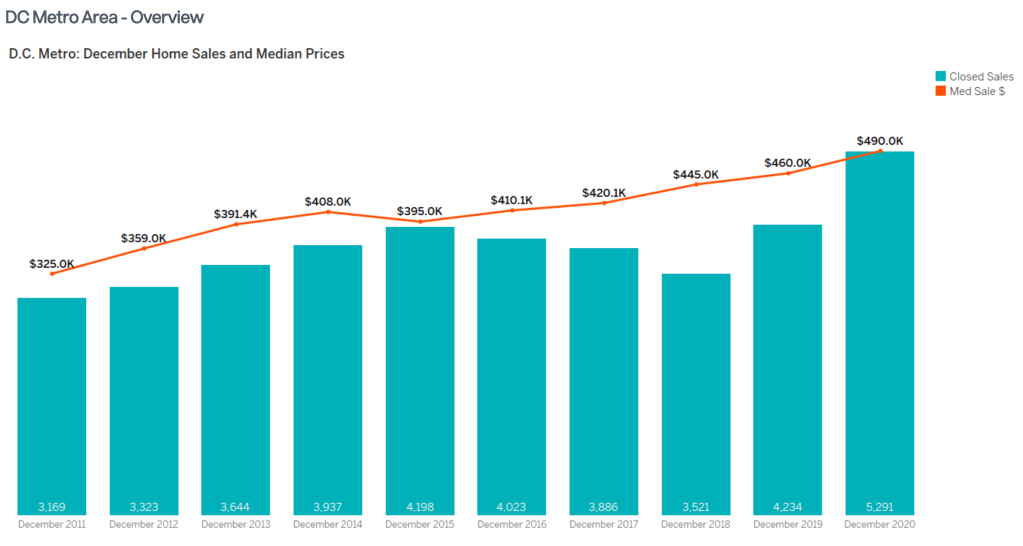
The following analysis of the Washington, D.C. Metro housing markets has been prepared by Bright MLS and is based on December 2020 Bright MLS housing data.
In Summary:
In 2020, the total sales dollar volume for the D.C. metro reached $34.6 billion (+11.7%).
Total sales volume for the year (57,266) ended up 3.3%. Seven months of the year marked ten-year monthly highs.
New listing volume was essentially flat with 2019. Combined with strong buyer demand, it created the region’s tightest market on record.
The year saw buyers snap up homes across the metro area, as days on the market fell into the single digits for the first time (nine days).
In December, new pending sales showed an unprecedented year-over-year growth, up 30.3% in a traditionally slow month. It was the best gain for any month in the past ten years.
No it’s not the pandemic; there we can only follow safety precautions and hope.
Rather it’s one of my clients’ timeline to Sell and Buy during 2020. How did they go from a home of 9 yrs, with three school-aged children and two full time working parents into a new build that will suit their family for the next 20+ years during an unimaginable world wide pandemic? One step at a time.
We first connected on October 20, 2019. From there, we developed an individual step by step plan of ‘how to’ execute their real estate goals. Following that plan led them to identifying the location, negotiating with the builder of their new home, and ratifying on Jan 1, 2020. Coordinating with the builder, designers, lender and title resulted in closing on October 2, 2020, three months behind schedule due to pandemic related delays.
Then it was time to list their home of 9 years.
Despite being three months behind our original timeline, we referred back to the step by stepplan we had created. Without skipping a beat, my clients stuck to the plan and completed everything we had discussed to get the house ready for market. We listed on a Thursday, ratified 5 days later on that Monday and closed in 21 days on November 30, 2020.