
The Number One Mistake Sellers Are Making: Overpricing Their House

In today’s housing market, many sellers are making a critical mistake: overpricing their houses. This common error can lead to a home sitting on the market for a long time without any offers. And when that happens, the homeowner may have to drop their asking price to try to re-ignite buyer interest.

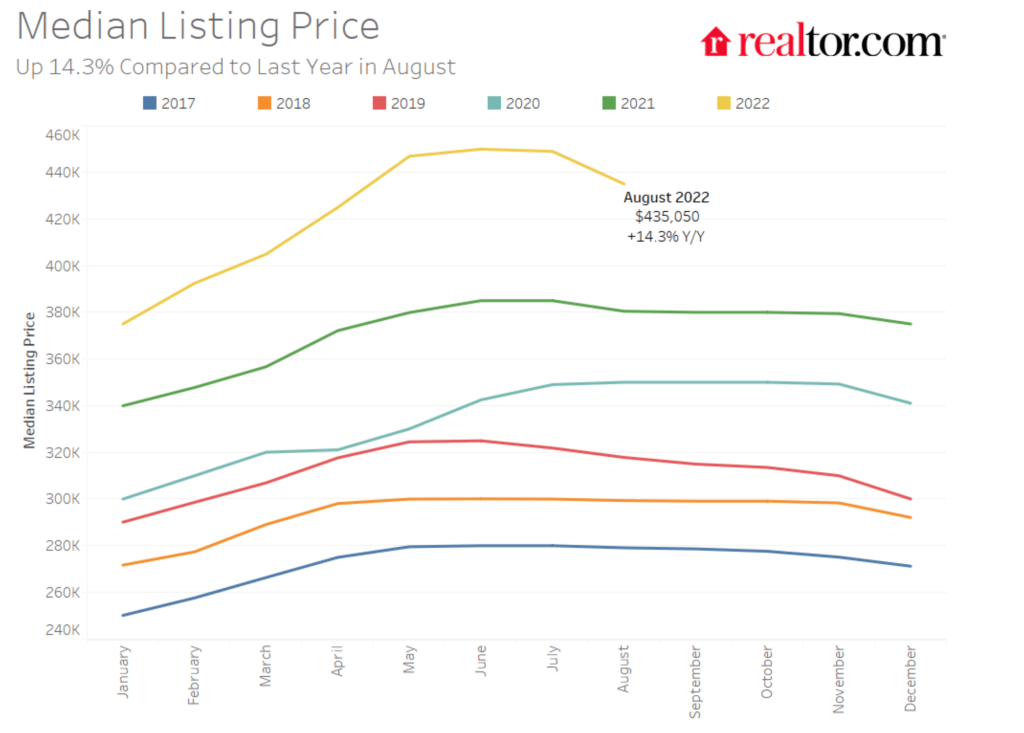
Data from Realtor.com shows the number of homeowners realizing this mistake and doing a price reduction is climbing (see graph below):

If you’re thinking about making a move yourself, here’s what you need to know. The best way to avoid making a costly mistake is to work with a trusted real estate agent to find the right price. Here’s a look at what’s at stake if you don’t.

Not Paying Attention To Current Market Conditions

Understanding current market conditions is key to accurate pricing. You don’t want to set your asking price based on what happened during the pandemic. The market has moderated a lot since then, so it’s far better to align your price with today’s reality.

Real estate agents stay updated on market trends and how they impact the pricing strategy for your house.

Pricing It Based on What You Want To Make (Not What It’s Worth)

Another misstep is pricing it based on what you want to make on the sale, and not necessarily current market value. You may see other homes in your neighborhood selling for top dollar and assume yours can do the same. But you may not be considering differences in size, condition, and features. For example, maybe that other house is waterfront or has a finished basement. To sum it up, Bankrate explains:

“How do you find that sweet spot of pricing for profit but not overpricing? The expertise of your agent can be truly valuable here. A knowledgeable agent will understand fair market value in your area, how much your house is worth and how much you might reasonably expect to get for it in the current market.”

An agent will do a comparative market analysis (CMA) to make sure your house is compared with truly similar properties to get an accurate look at how it should be priced.

Pricing High to Leave Room for Negotiation

Another common, yet misguided strategy is to price your house high on purpose, so you have more room to negotiate down during the sale. But this can backfire. A price that seems too high often deters potential buyers from even considering the home. So rather than leaving room for negotiation, what you’ll actually be doing is turning buyers away. U.S. News Real Estate explains:

“You want to sell your house for top dollar, but be realistic about the value of the property and how buyers will see it. If you’ve overpriced your home, chances are you’ll eventually need to lower the number, but the peak period of activity that a new listing experiences is already gone.”

An agent can help you set a fair price that attracts buyers and encourages more competitive offers.

Bottom Line

Overpricing your home can have serious consequences. A knowledgeable real estate agent brings an objective perspective, in-depth market knowledge, and a strategic approach to pricing.

Let’s connect so you can avoid making a pricing mistake that’ll cost you.


What Every Homeowner Should Know About Their Equity

Curious about selling your home? Understanding how much equity you have is the first step to unlocking what you can afford when you move. And since home prices rose so much over the past few years, most people have much more equity than they may realize.

Here’s a deeper look at what you need to know if you’re ready to cash in on your investment and put your equity toward your next home.

Home Equity: What Is It and How Much Do You Have?

Home equity is the difference between how much your house is worth and how much you still owe on your mortgage. For example, if your house is worth $400,000 and you only owe $200,000 on your mortgage, your equity would be $200,000.

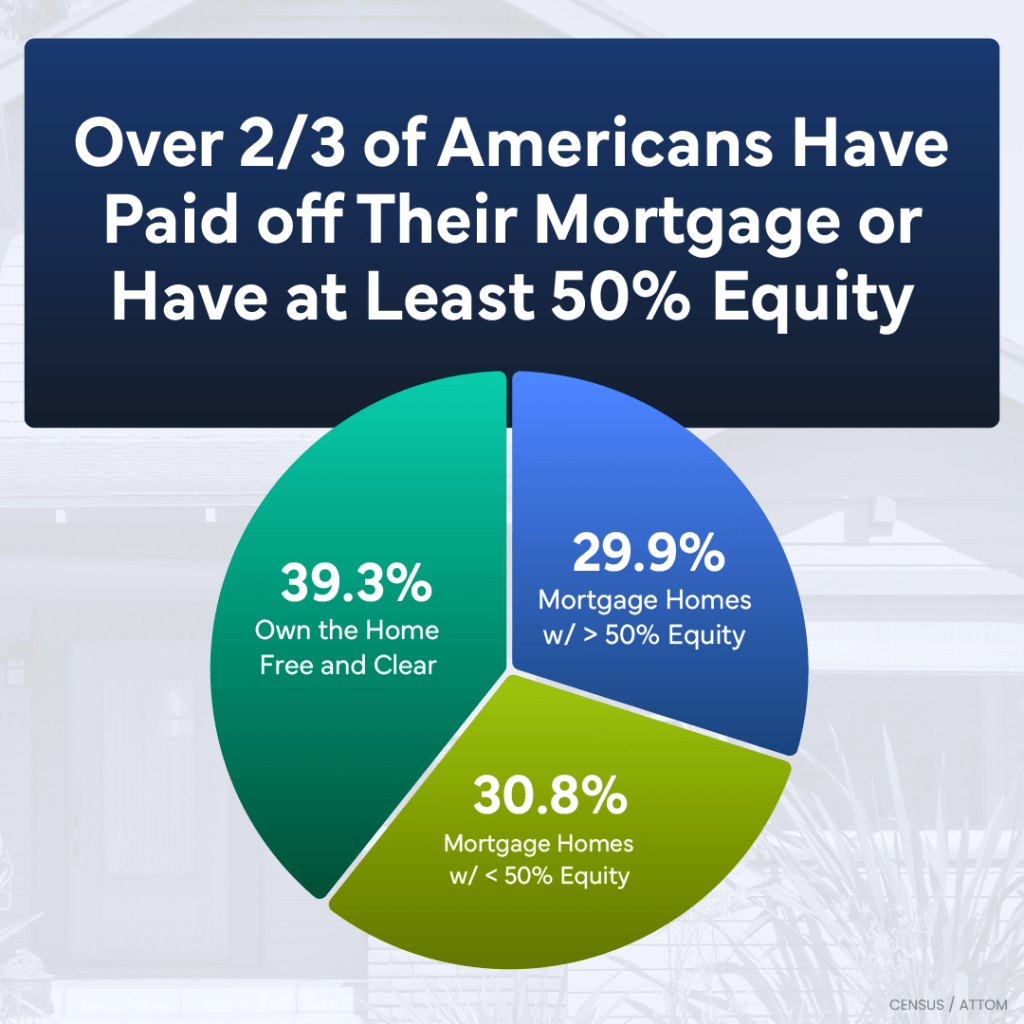
Recent data from the Census and ATTOM shows Americans have significant equity right now. In fact, more than two out of three homeowners have either completely paid off their mortgages (shown in green in the chart below) or have at least 50% equity in their homes (shown in blue in the chart below):

Today, more homeowners are getting a larger return on their homeownership investments when they sell. And if you have that much equity, it can be a powerful force to fuel your next move.

What You Should Do Next

If you’re thinking about selling your house, it’s important to know how much equity you have, as well as what that means for your home sale and your potential earnings. The best way to get a clear picture is to work with your agent, while also talking to a tax professional or financial advisor. A team of experts can help you understand your specific situation and guide you forward.

Bottom Line

Home prices have gone up, which means your equity probably has too. Let’s connect so you can find out how much you have in your home and move forward confidently when you sell.


First-time Buyers Back Despite Challenges

They now make up 45% of all homebuyers, up from 37% last year, even as affordability issues persist. Repeat buyers may have pulled back due to rising interest rates.

CHARLOTTE, N.C. – First-time home buyers have returned to the housing market, and those who can afford a home are finding success after years of setbacks. The share of buyers purchasing a home for the first time has rebounded to pre-pandemic levels.

First-time buyers now represent 45% of all buyers, up from 37% of buyers surveyed last year, according to Zillow’s 2022 Consumer Housing Trends Report. If they can overcome affordability challenges, first-time buyers could be well positioned to continue increasing their share in today’s shifting market, with more options and time to decide on the right home.

The share of first-time buyers plummeted during the pandemic amid rapidly rising home values and tough competition, even with high demand coming from the large millennial generation. Zillow research found younger, likely first-time shoppers were losing out to older, repeat buyers who were able to tap the equity in their existing homes and use cash to make a stronger offer. A Zillow survey found younger buyers were more likely to report losing to an all-cash buyer at least once, as was the case for 45% of Gen Z and 38% of millennial buyers, compared to 30% of all buyers.

“First-time buyers now appear to be making relative gains as high mortgage interest rates disproportionately encourage current homeowners to stay put,” said Zillow population scientist Manny Garcia. “The flow of homes into the market is slowing, suggesting homeowners are likely comparing their current low mortgage rate to today’s rates and deciding not to move. While rising mortgage rates are hurting affordability for all buyers, first-time buyers may be less deterred by higher rates because they’re comparing a monthly mortgage payment to what they’re paying in rent.”

First-time buyers are making up a larger share of a smaller pie. Newly pending home sales were down 29% in August, compared to a year prior, as buyers struggle to keep up with higher home prices and interest rates. Home values remain 14.1% higher than last year, even after two consecutive month-over-month declines. When combined with rising mortgage interest rates, the typical monthly payment on a home is nearly 60% higher today than it was a year ago.

Recent Zillow research finds those affordability challenges have driven up demand for the lowest-priced homes in each market. While there are fewer buyers overall, first-time buyers may find more competition for starter homes.

The silver lining is that today’s much-needed market rebalancing has the potential to especially benefit first-time buyers, who have the flexibility to shop without trying to time the purchase of their new home with the sale of an existing home. Listings typically lingered 16 days on the market in August before going under contract, compared to eight days in June, meaning buyers have twice as much time to decide on a home compared to this time last year.

First-time buyers may also have more bargaining power as a growing number of sellers drop their prices. The share of listings with a price cut grew to roughly 28% in August, according to Zillow’s latest monthly market report.

As the market changes, aspiring first-time buyers may need to change their approach. These five tips are a good starting point:

  • Understand what’s affordable. As mortgage interest rates fluctuate, aspiring buyers can start with a mortgage calculator to understand what they can realistically afford on a monthly basis. Take into account some of the hidden costs of homeownership, such as property tax, insurance and HOA dues, which can add up to more than $750 per month. But it’s always best to leave some wiggle room in the budget for unexpected maintenance projects and emergency repairs. First-time shoppers should also explore down payment assistance programs they may qualify for.
  • Finance first. First-time buyers can gain a competitive edge by getting pre-approved for a mortgage. A Zillow survey finds 86% of sellers prefer a buyer who has been pre-approved, as opposed to pre-qualified, for a mortgage. This financial check gives sellers more certainty that a buyer will close on time, and it allows buyers to make a stronger, faster offer the minute the right home hits the market. Buyers can start the pre-approval process online. Don’t hesitate to try, try, try again. Nearly half of all first-time buyers (47%) are denied a mortgage at least once before ultimately getting approved.
  • Hire the right agent. An experienced agent will have a finger on the pulse of their local market and know all the changes happening in it, and they can help buyers make strategic decisions to win. They’ll know when to come in with an offer under list price or when to expect a bidding war. Buyers should plan on interviewing their top candidates and asking the right questions.
  • Shop smarter with tech. New real estate technology can help first-time buyers make faster, smarter decisions. Virtual 3D Home tours and interactive floor plans give shoppers a more authentic experience of a home, allowing them to quickly narrow down their options and tour fewer homes in person.
  • Keep the contingencies. With less competition, first-time buyers should have the leverage to include important contingencies in their offers that could potentially save them a lot of money in the long run. An inspection contingency can identify major structural, mechanical or safety issues that could be extremely costly to repair and cause buyer’s remorse. A financing or appraisal contingency will ensure a buyer can walk away with their earnest money if a home fails to be appraised for the offer price or if their financing falls through.

Copyright © 2022 BridgeTower Media and © 2022, The Mecklenburg Times (Charlotte, NC). All rights reserved.


August 2022 Monthly Housing Market Trends Report


Sabrina Speianu, Economic Data Manager, realtor.com®

  • The national inventory of active listings increased by 26.6% over last year. 
  • The total inventory of unsold homes, including pending listings, increased by just 1.3% year-over-year due to a decline in pending inventory (-21.9%). 
  • Selling sentiment declined and listing activity followed, with newly listed homes declining by 13.4% on a year-over-year basis.
  • The median list price grew by 14.3% in August, a deceleration from recent highs.
  • Time on market was 42 days, 5 days more than last year but 22 days less than typical pre-pandemic levels.
  • Regionally, large Western markets which saw some of the most growth last year and earlier this year are now showing the greatest signs of deceleration, with larger inventory increases, more price reductions, and more quickly decelerating price growth than other regions. 

Read the FULL article


Rising Prices Push Home Equity to Its Highest Level in 10 Years

Source: Rising Prices Push Home Equity to Its Highest Level in 10 Years
Highlights:

  • Homeowners with a mortgage gained a 29.3% year-to-year increase. It’s the biggest jump since 2Q 2010.
  • Wolf projects that U.S. home price growth will slow to about 5% next year
  • Wolf said. “Those who have chosen not to purchase a home or have been unable to are finding it very hard to enter the market now, and in a lot of cases these individuals are missing out on wealth accumulation.”

LOS ANGELES (AP) – Soaring home prices have pushed up average homeowner equity growth to the highest level in more than a decade, though recent signs of a cooling U.S. housing market point to more moderate gains in the second half of the year.

Homes with a mortgage gained an average of $51,500 in equity in the second quarter, an increase of 29.3% from the April-June quarter last year, according to real estate information company CoreLogic. That’s the highest quarterly average gain in home equity since the second quarter of 2010, the firm said.

That works out to nearly $3 trillion in equity gained by U.S. homeowners with a mortgage, which is about 63% of all homes, CoreLogic said. Average homeowner equity jumped nearly 20% in the first quarter from a year earlier.

Home equity growth can have broad impacts on the economy, giving homeowners more financial flexibility to spend on big purchases or build a nest egg. Rising home values also make it increasingly tougher for would-be homeowners to buy.

Homeowners in California, Washington state and Idaho saw among the biggest average equity increases in the second quarter: $116,000 in California, $103,000 in Washington state and $97,000 in Idaho.

The surge in homeowner equity gains follows a record run up in U.S. home prices this year amid a searing hot housing market fueled by ultra-low mortgage rates, a thin inventory of properties for sale and many would-be buyers’ desire for more living space during the pandemic.

S&P said this week that its closely watched S&P CoreLogic Case-Shiller 20-city home price index surged 19.9% in July from a year earlier, the largest gain on records dating back to 2000.

Still, there are signs the soaring home price gains fueling homeowner equity may have peaked. The National Association of Realtors’ most recent housing market snapshot showed the median home price of previously occupied U.S. homes rose 14.9% in August from a year earlier to $356,700. That’s a more modest gain than earlier this year, when year-over-year increases were running at 20%-25%.

“It seems that there was that shift from July to August where there starts to be a little bit of pushback in terms of where prices have gone,” said Ali Wolf, chief economist at Zonda Economics, a real estate industry tracker.

Wolf projects that U.S. home price growth will slow to about 5% next year, citing expectations of modestly higher mortgage rates and a small but notable increase in the number of homes on the market.

“The days of runaway home price growth are behind us,” she said.

In its most recent quarterly housing forecast, mortgage buyer Freddie Mac envisions home prices growing 5.3% next year, down from a projected 12.1% increase in 2021.

If those home price outlooks hold, it would translate into a less torrid pace for homeowner equity growth next year. Still, the outsized growth in homeowner equity this year will have ripple effects for the broader economy, and the housing market. Rising homeowner equity creates a buffer for borrowers against potential financial hardship, such as job loss. And it can give homeowners financial flexibility to borrow against their equity to pay off high-interest debt or finance large purchases, such as home improvement projects, which can give a boost to the economy.

“It is good for wider economic growth, but there’s an ugly side to today’s level of pricing,” Wolf said. “Those who have chosen not to purchase a home or have been unable to are finding it very hard to enter the market now, and in a lot of cases these individuals are missing out on wealth accumulation.”

The surge in home prices this year has made it tougher for would-be homeowners to buy. First-time buyers accounted for 29% of home sales in August, according to the National Association of Realtors. A year ago they made up 33% of buyers.

The U.S. homeownership rate was 65.4% in the second quarter, down from 66.6% last year and 66.2% a decade ago.

The increase in home equity has helped limit the number of homeowners who end up “underwater” on their mortgage, or owing more on their loan than their home is worth. Also known as being in negative equity, that can happen when a home’s value declines, or when the size of the mortgage increases, say when someone takes out a home equity loan.

At the end of the second quarter, 1.2 million homes, or 2.3% of all U.S. homes with a mortgage, were in negative equity, CoreLogic said. That’s down 30% from the same quarter last year.

Among U.S. metropolitan areas, Chicago had the biggest share of homes with negative equity in the April-June quarter at 5.2%, the firm said.


Hopeful Buyers Welcome Inventory Increase

More homes are coming onto the market, opening up greater opportunities for prospective buyers across the country.

Source: Hopeful Buyers Welcome Inventory Increase

As more homes enter the marketplace, opportunities for prospective buyers continue to increase in regions across the country, said NAR President Charlie Oppler. Housing inventories increased 7.3% in July compared to June, reaching 1.32 million homes for sale.

“We see inventory beginning to tick up, which will lessen the intensity of multiple offers,” said Lawrence Yun, NAR’s chief economist. “Much of the home sales growth is still occurring in the upper-end markets, while the mid- to lower-tier areas aren’t seeing as much growth because there are still too few starter homes available.”

But home prices continue to surge. The median existing-home price for all housing types in July was $359,900, an increase of nearly 18% compared to a year ago.

“Although we shouldn’t expect to see home prices drop in the coming months, there is a chance that they will level off as inventory continues to gradually improve,” Yun said. “In the meantime, some prospective buyers who are priced out are raising the demand for rental homes and thereby pushing up the rental rates.”


The Need For More Inventory Has Never Been More Apparent

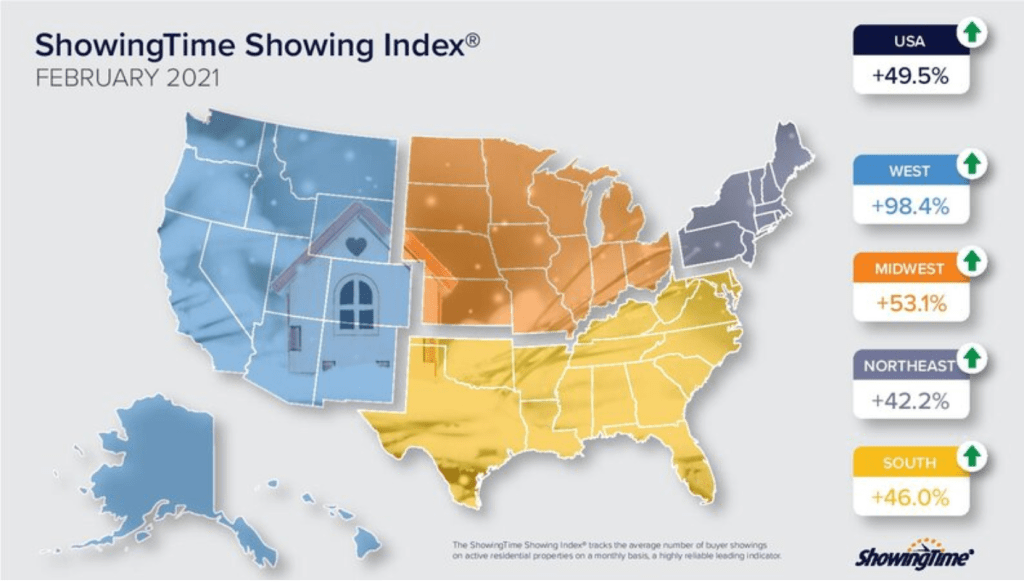
Based on compiled data from more than six million property showings scheduled across the country, Home Buyer Demand jumps 98.4% in the West as traffic grows again nationwide.

  • March 24, 2021 – Dwindling inventory was again met with an outpouring of buyer demand throughout the country in February as an unprecedented 75 markets reported double-digit growth, according to the ShowingTime Showing Index®
  • Nationwide, buyer traffic jumped 49.5 percent, continuing a trend of national year-over-year growth in buyer demand that began in May 2020.
  • “In March and April, year-over-year comparisons will be less meaningful as the onset of COVID-19 in 2020 drove showing traffic down in those two months, but on a month-to-month basis we’re still likely to see further seasonal increases in demand, taking us further into this unprecedented direction. We expect that this will correlate with continued broad increases in prices.”


Americans have saved $1.6 trillion since the pandemic began.

Where To Spend All That Savings | An Opportunity To Build Wealth

  • Americans have saved $1.6 trillion since the pandemic started, per the Commerce Department.

  • That’s roughly half of overall global savings during the pandemic, and the same as South Korea’s GDP.

  • It’s also greater than the output gap, or economic hole created by Covid-19, signaling a coming economic boom.

Experts are currently projecting 4.6% growth for US GDP this year, per Bloomberg. If Americans spend all the money they saved in the past year, that could jump to 9%; whereas if they don’t, the GDP forecast could drop to 2.2%.

It’s why so many economists are predicting that lockdown lifting will see the biggest boomtime in a generation, potentially ushering in a new era in the US economy.

*Read full Insider article