Is It A Buyers Market? It Depends

Lisa Sturtevant PhD Bright MLS, Housing Economist

Inventory is climbing, which has been welcome news for prospective homebuyers. However, the inventory picture is very different depending on where you are and the type of home you’re looking for.

According to data from realtor.com, at the end of May 2025, total inventory across the U.S. was at about 90% of the May 2019 level. But a very distinct pattern emerges when you look at inventory by metro area. Inventory levels surpass 2019 levels in southern metros in Florida, Texas, and Arizona as well as in Washington and Oregon in the Pacific Northwest. By contrast, inventory across the Midwest and Northeast, as well as in Southern California, remains below 2019 levels.

Mid-Atlantic inventory remains tight

In the Bright MLS service area, which covers six states and the District of Columbia, there were 42,981 active listings on the market at the end of May 2025. The number of active listings is now 25.1% higher than it was a year ago and inventory has been increasing across the Mid-Atlantic region for 16 consecutive months, as more homes are listed for sale and properties remain on the market longer.

However, despite the rapid rise, inventory is still well below pre-pandemic levels in most local markets across the Bright MLS service area. Overall, May 2025 inventory is just 64% of the May 2019 level across Bright’s footprint. In fact, there are just a handful of counties in the region where inventory has surpassed 2019 levels.

The urban area housing markets tend to have more inventory. In both Philadelphia and Washington, D.C., inventory is above pre-pandemic levels. In the close-in suburbs of Arlington and Alexandria, Virginia, inventory has also surpassed what was available to buyers in 2019.

There are many more local markets where inventory is still less than half of what was available in 2019. In most of the Philadelphia suburbs, for example, the number of active listings in May 2025 is less than 50% of May 2019 levels.
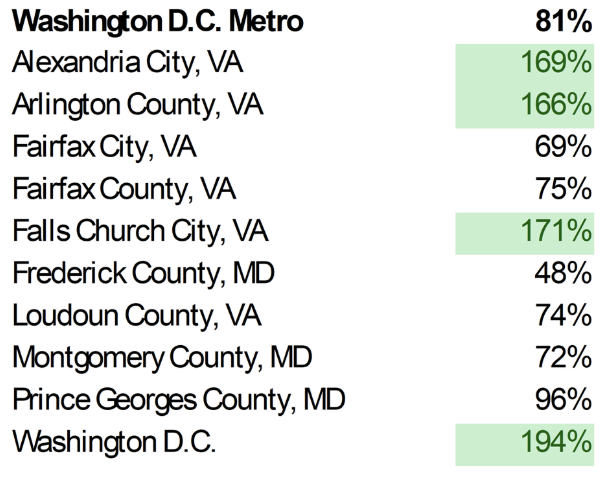
So, while more inventory is a welcome change for homebuyers in the marketplace, inventory is still relatively tight across much of the Mid-Atlantic region and sellers do still have the upper hand in the market.

read full Bright MLS article


Homeowner Net Worth Has Skyrocketed

If you’re weighing your options to decide whether it makes more sense to rent or buy a home today, here’s one key data point that could help you feel more confident in making your decision. Every three years, the Federal Reserve Board releases the Survey of Consumer Finances (SCF). That report covers the difference in net worth for both homeowners and renters. Spoiler alert: the gap between the two is significant.

The average homeowner’s net worth is almost 40X greater than a renter’s. And here’s the data to prove it (see graph below):

The Big Reason Homeowner Net Worth Is So High

In the previous version of that report, the net worth of the average homeowner was roughly $255,000 and that of the average renter was $6,300. But in the release that just came out this year, the gap widened as homeowner net worth climbed dramatically. As the Survey of Consumer Finances (SCF) report says:

“. . . the 2019-2022 growth in median net worth was the largest three-year increase over the history of the modern SCF, more than double the next-largest one on record.”

One of the biggest reasons homeowner net worth skyrocketed is home equity.

Over the last few years, known as the ‘unicorn’ years for housing, home prices went through the roof. That’s because there weren’t enough homes for sale, and there was a big influx of buyers rushing to buy them and take advantage of the then record-low mortgage rates. That imbalance of supply and demand pushed prices higher and higher. As a result, most homeowners who had a home during that time saw their equity grow a lot.

If you’re still in the middle of making your decision on whether to rent or buy, you may wonder if you missed the boat on the big net worth boost. But here’s what you need to realize. As a recent article in The Ascent explains:

Whether your net worth increased in recent years or not, there are steps you can take to boost that number in the coming years. . . buying a home can be a great way to grow your net worth, since home values have a tendency to rise over time.”

Historically, home prices climb over time. Even now that mortgage rates are closer to 7-8%, prices are still rising in many areas of the country because supply is still low compared to demand. That’s why expert forecasts for the next few years call for ongoing appreciation – just at a pace that’s more typical for the housing market.

While it likely won’t be the record ramp-up that happened over the last few years, people who buy now should continue to grow equity in the years ahead. That means, if you’re ready and able to buy a home today, you’ll be making an investment that’ll help build your net worth in the long run.

As Jessica Lautz, Deputy Chief Economist at the National Association of Realtors (NAR), says:

“. . . when deciding to rent vs buy, one must calculate the total cost of homeownership (maintenance, utilities, commuting, etc.) and the total financial benefit. Based on new Fed data . . . the median net worth of homeowners was $396,200 vs renters at $10,400. There is no question about the wealth gains that homeownership provides.”

Bottom Line

If you’re on the fence about whether to rent or buy a home, remember that homeownership can give your net worth a big boost over time. If you want to learn more about this or the many other benefits of owning a home, let’s connect.


Mortgage rates will continue ticking up

By Clare Trapasso
Dec 1, 2021

3 of a 3 part series
Highlights:

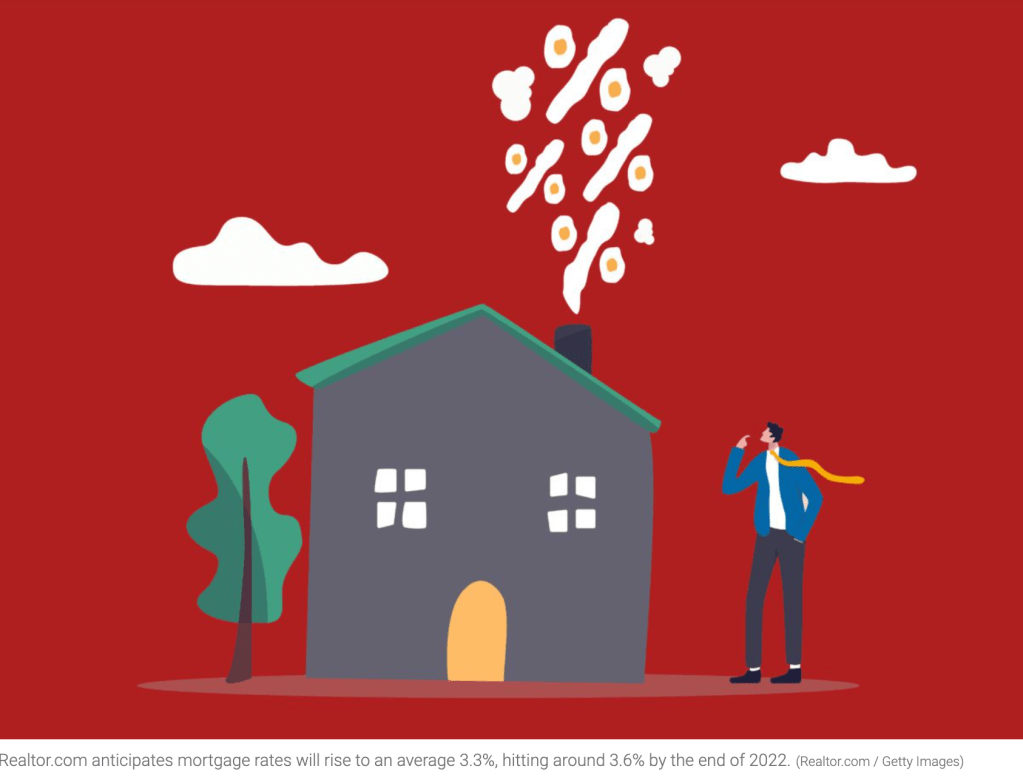
  • Realtor.com anticipates mortgage rates will rise to an average 3.3%, hitting around 3.6% by the end of 2022.
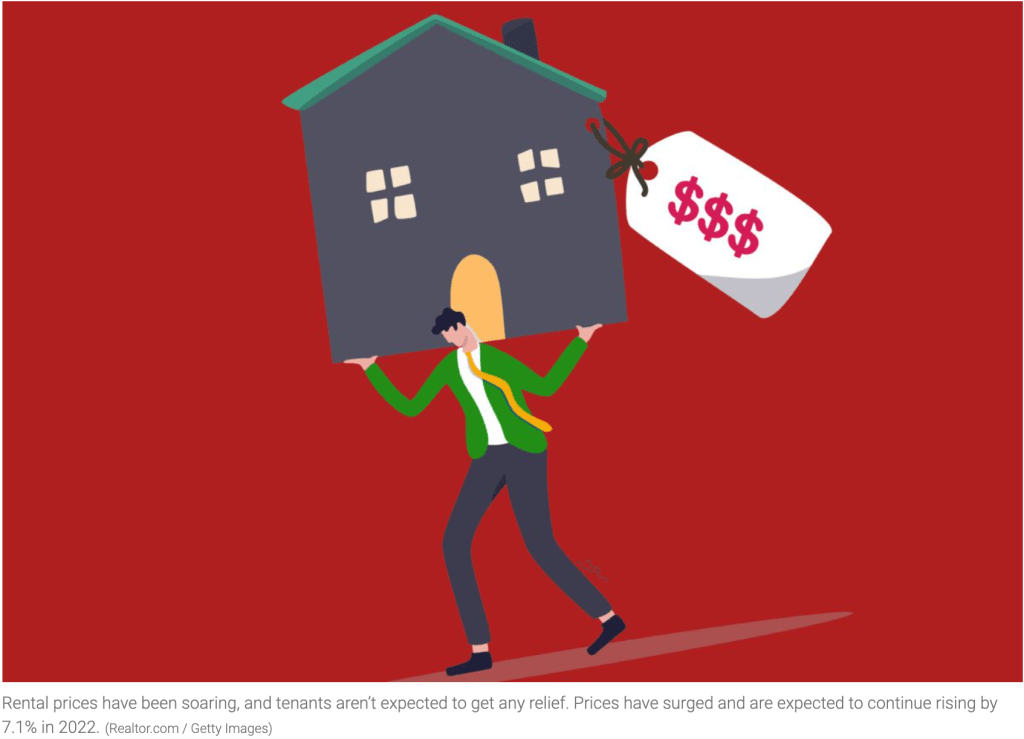
  • Rental prices have been soaring, and tenants aren’t expected to get any relief. Prices have surged and are expected to continue rising by 7.1% in 2022.
  • The culprit behind the price hikes: There simply aren’t enough homes to go around—for rent or sale.

Mortgage rates have been the wild card to the housing market during the pandemic. Low rates at the start of COVID-19 helped fuel dizzying price jumps as buyers could afford to spend more on homes. That’s because they were paying less interest each month so they could absorb the higher home prices.

However, as the economy has improved and inflation has risen, making everything from a dozen eggs to a gallon of gas more expensive, rates are also expected to go up. That could help curb the runaway price growth that was seen in the spring. Buyers can stretch their budgets only so far.

Realtor.com anticipates mortgage rates will rise to an average 3.3%, hitting around 3.6% by the end of 2022. That’s up from a low of 2.65% in the first week of January for 30-year fixed-rate loans, according to Freddie Mac data.

While that doesn’t sound like much of a hike, it adds up.

The difference of roughly a percentage point to 3.6% would result in about $157 extra tacked on to the monthly payment of a median-priced home of $380,000. That can total more than $56,500 over the life of a 30-year loan. (This assumes the buyers put down 20% and does not include property taxes, insurance costs, or homeowners association fees.)

It’s also likely to result in homebuying becoming even more expensive. With home prices continuing to tick up a little and rates increasing, those purchasing a home with a mortgage will wind up shelling out more each month.

Rents will keep shooting up higher than home prices

It isn’t just homebuying that’s gotten more expensive. Rental prices have been soaring, and tenants aren’t expected to get any relief. Prices have surged and are expected to continue rising by 7.1% in 2022.

At the beginning of the pandemic, as home sale prices spiraled, rents in many of the big cities dropped precipitously. Many tenants moved to larger, nicer apartments with more amenities at deeply discounted rents. Then this year, they were hit with steep increases even in smaller, more traditionally affordable cities and suburbs.

The culprit behind the price hikes: There simply aren’t enough homes to go around—for rent or sale. Many aspiring homebuyers who keep losing bidding wars or can’t afford high homes prices are stuck renting. Plus, there are plenty of folks who moved in with family and roommates or split up with their partners during the pandemic who are looking for their own rentals.

“With apartment vacancies still near historic lows and landlords making up for lost rent increases during the pandemic, rents are expected to continue to grow,” says Hale.


It Started With A Referral

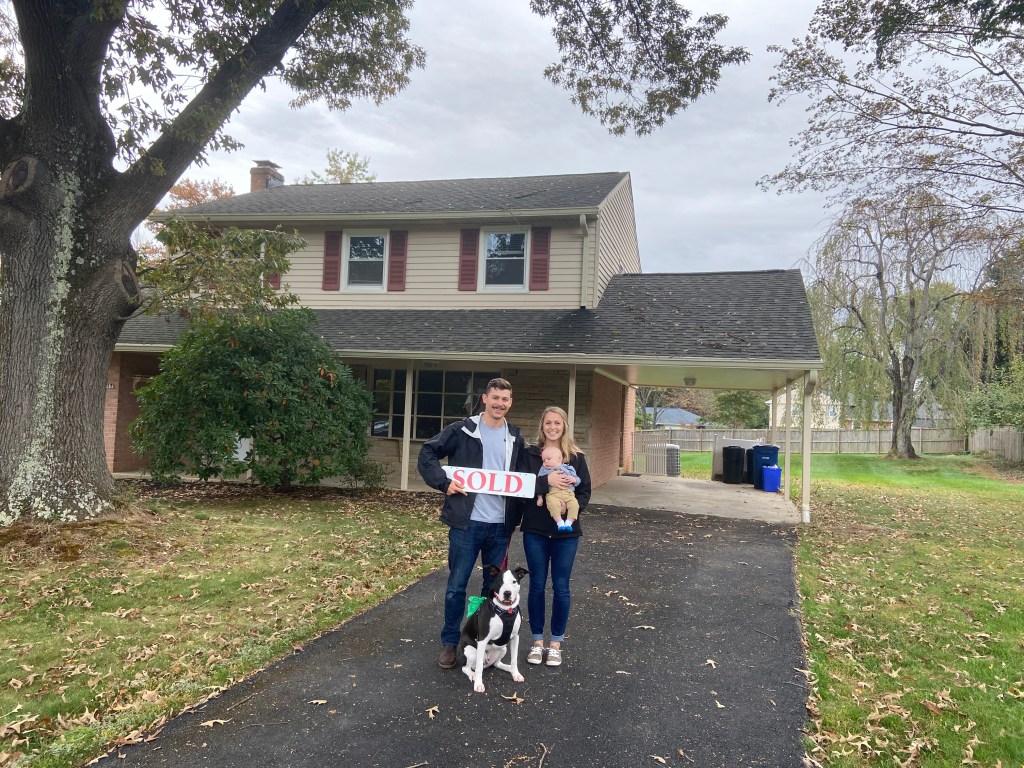
One referral turned into two resulting in two happy clients. Now we are all connected.

Congratulations to Chad, Katie and Logan.

It started with a reciprocal referral from a California agent whose son’s best friend wanted a bigger home for his expanding family. As a recent grad from the
United States Naval Academy, becoming a parent to a son and adopted dog Lucky, with mom planning to go back to work and what looked like, job wise a longer stint in Maryland it was time to move, Covid-19 and all. We are currently operating in a highly competitive market with historically low interest rates. After 27+ house tours, interviewing 2 lenders, investing in a pre-home inspection, 3 written and submitted yet rejected offers, they closed on the house that was meant to be. 10,000 lower than list price, plus a seller credit. Well worth the effort. Congratulations! #BestClientsEver


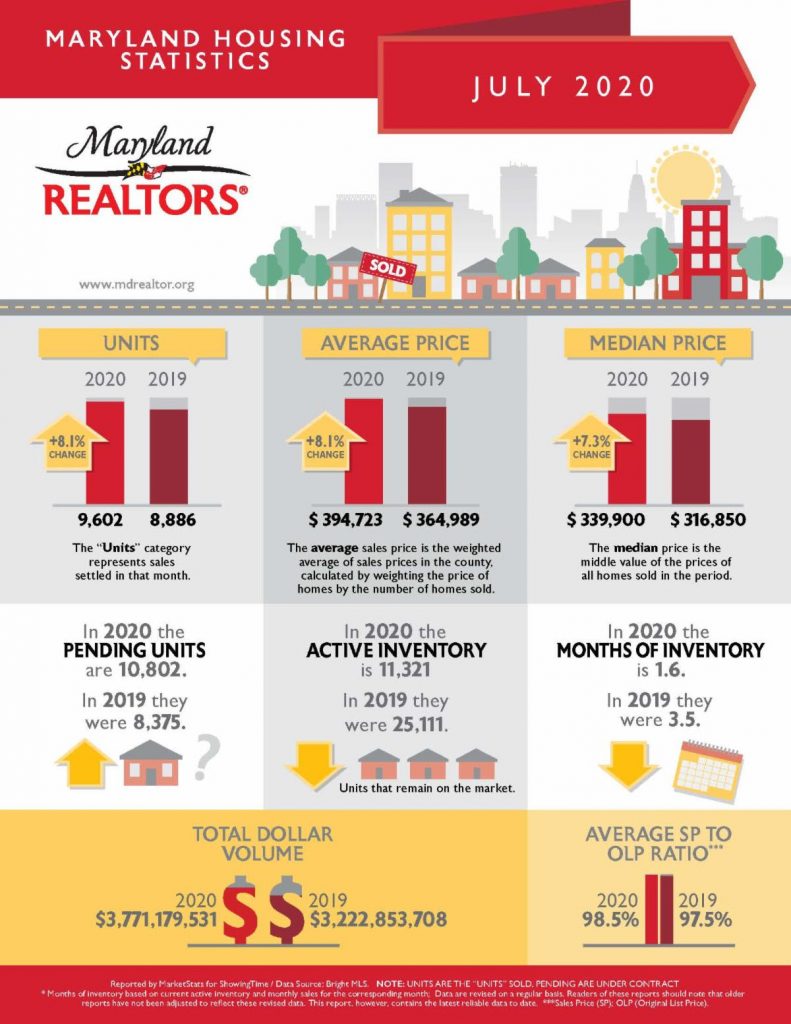
09.28.2020 Maryland Real Estate Trends Echos Much Of The Countries


August Housing Data Reveals a Robust Summer Market Amidst Declines in Inventory

  • Median Sale Price is up 9.7%
  • Average Sale Price up 11.2%
  • Months of Inventory down 60% to 1.4 months
  • Median days on market are down from 22 to 9
  • Seven of Maryland’s rural counties have seen over 20 percent increases in average prices over last year.
ANNAPOLIS, MD – September 28, 2020 Maryland’s August housing market demonstrated substantial recovery from spring’s COVID-related disruptions, according to housing statistics released by Maryland REALTORS®*. Data from June through August show both an increase in average and median home prices, and a decline in months of available inventory, echoing nationwide trends and sparking concern over housing imbalances.

“The average sales price increased year-over-year from $361,823 to $402,452 and the median price increased from $310,000 to $340,000, growth of 11.2 percent and 9.7 percent, respectively” said Maryland REALTORS® President John A. Harrison. “Months of inventory dropped 60 percent to just 1.4 months, compared to 3.5 last year, which is a historic low for the state. Moreover, the median days on market fell from 22 to 9 which aligns with stories we’ve heard of bidding wars and homes selling within hours of hitting the market.”

“The most notable, but unsurprising, feature of the current housing market is the sharp rise in activity in rural areas,” said Harrison. Seven of Maryland’s rural counties have seen over 20 percent increases in average prices over last year. With the rise in working from home, commute times are less of a factor. That and the relative affordability of rural areas make urban and some suburban communities less attractive. “The pandemic has prompted individuals and families to reimagine their housing requirements, often desiring home office space and more expansive outdoor living areas.”

Pending Home Sales Notch Record-Setting 44.3% Monthly Increase in May

A Historic Rebound for the Housing Market

A Historic Rebound for the Housing Market | MyKCM

Pending Home Sales increased by 44.3% in May, registering the highest month-over-month gain in the index since the National Association of Realtors (NAR) started tracking this metric in January 2001. So, what exactly are pending home sales, and why is this rebound so important?

According to NAR, the Pending Home Sales Index (PHS) is:

“A leading indicator of housing activity, measures housing contract activity, and is based on signed real estate contracts for existing single-family homes, condos, and co-ops. Because a home goes under contract a month or two before it is sold, the Pending Home Sales Index generally leads Existing-Home Sales by a month or two.”

In real estate, pending home sales is a key indicator in determining the strength of the housing market. As mentioned before, it measures how many existing homes went into contract in a specific month. When a buyer goes through the steps to purchase a home, the final one is the closing. On average, that happens about two months after the contract is signed, depending on how fast or slow the process takes in each state.

Why is this rebound important?

A Historic Rebound for the Housing Market | MyKCM

With the COVID-19 pandemic and a shutdown of the economy, we saw a steep two-month decline in the number of houses that went into contract. In May, however, that number increased dramatically (See graph below):This jump means buyers are back in the market and purchasing homes right now. Lawrence Yun, Chief Economist at NAR mentioned:

“This has been a spectacular recovery for contract signings and goes to show the resiliency of American consumers and their evergreen desire for homeownership…This bounce back also speaks to how the housing sector could lead the way for a broader economic recovery.”

But in order to continue with this trend, we need more houses for sale on the market. Yun continues to say:

“More listings are continuously appearing as the economy reopens, helping with inventory choices…Still, more home construction is needed to counter the persistent underproduction of homes over the past decade.”

A Historic Rebound for the Housing Market | MyKCM

As we move through the year, we’ll see an increase in the number of houses being built. This will help combat a small portion of the inventory deficit. The lack of overall inventory, however, is still a challenge, and it is creating an opportunity for homeowners who are ready to sell. As the graph below shows, during the last 12 months, the supply of homes for sale has been decreasing year-over-year and is not keeping up with the demand from homebuyers.

Bottom Line

If you decided not to sell this spring due to the health crisis, maybe it’s time to jump back into the market while buyers are actively looking for homes. Let’s connect today to determine your best move forward.


COVID-19: How Deep Will The Impact Go?

Looking to the Future: What the Experts Are Saying

Looking to the Future: What the Experts Are Saying | MyKCM

As our lives, our businesses, and the world we live in change day by day, we’re all left wondering how long this will last. How long will we feel the effects of the coronavirus? How deep will the impact go? The human toll may forever change families, but the economic impact will rebound with a cycle of downturn followed by economic expansion like we’ve seen play out in the U.S. economy many times over.

Here’s a look at what leading experts and current research indicate about the economic impact we’ll likely see as a result of the coronavirus. It starts with a forecast of U.S. Gross Domestic Product (GDP).

According to Investopedia:

“Gross Domestic Product (GDP) is the total monetary or market value of all the finished goods and services produced within a country’s borders in a specific time period. As a broad measure of overall domestic production, it functions as a comprehensive scorecard of the country’s economic health.”

Looking to the Future: What the Experts Are Saying | MyKCM

When looking at GDP (the measure of our country’s economic health), a survey of three leading financial institutions shows a projected sharp decline followed by a steep rebound in the second half of this year:A recent study from John Burns Consulting also notes that past pandemics have also created V-Shaped Economic Recoveries like the ones noted above, and they had minimal impact on housing prices. This certainly gives hope and optimism for what is to come as the crisis passes.

Looking to the Future: What the Experts Are Saying | MyKCM

With this historical analysis in mind, many business owners are also optimistic for a bright economic return. A recent PricewaterhouseCoopers survey shows this confidence, noting 66% of surveyed business owners feel their companies will return to normal business rhythms within a month of the pandemic passing, and 90% feel they should be back to normal operation 1 to 3 months after:From expert financial institutions to business leaders across the country, we can clearly see that the anticipation of a quick return to normal once the current crisis subsides is not too far away. In essence, this won’t last forever, and we will get back to growth-mode. We’ve got this.

Bottom Line

Lives and businesses are being impacted by the coronavirus, but experts do see a light at the end of the tunnel. As the economy slows down due to the health crisis, we can take guidance and advice from experts that this too will pass.


2019 in REview

By providing market knowledge and experience that lets clients break down the process step by step, we make their experience a positive and exciting one. A metric for Laurel Murphy Real Estate to gauge whether we are achieving our goal is the percent of business we do from referrals or repeat business. 

In our first full year we serviced 50% sellers and 50% buyers with 85% from referrals or repeat clients. Helping family and friends of past clients is a responsibility we appreciate and take seriously.  Going into 2020 we have every intention to increase our numbers, one referral at a time.